Villisca Axe Murders
USA
Case Overview
Total Victims
8Suspects Listed
5Description
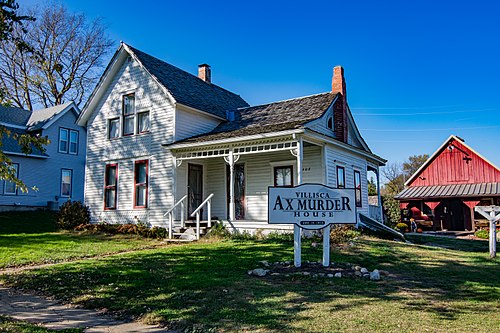
The Villisca Axe Murders refer to the brutal unsolved killing of eight people in a small house in Villisca, Iowa, in 1912. The case remains one of the most haunting family massacres in American history, largely due to the lack of a confirmed suspect and the eerie circumstances surrounding the crime scene. Over a century later, it continues to draw attention for both its brutality and its unanswered questions. The victims were members of the Moore family and two young guests who had been staying overnight. In the early hours of June 10, 1912, all eight individuals were killed inside the home while they slept. The weapon used was an axe belonging to the family, which was left at the scene. There were no clear signs of forced entry, and the attack appeared to have occurred while the victims were unaware, adding to the disturbing nature of the case. The discovery was made later that morning when neighbors became concerned after seeing no activity at the house. What they found inside revealed a scene of extreme violence, with every occupant of the home having been killed. However, before law enforcement could properly secure the location, the crime scene was heavily disturbed by members of the public who entered the house out of curiosity. Items were moved, surfaces were touched, and potential evidence was handled or removed, severely compromising the investigation. In one of the more disturbing accounts, it is reported that a piece of one victim's skull was even taken as a grim "souvenir." This uncontrolled interference added significant difficulty for investigators, who were already limited by the forensic methods of the time. The investigation into the Villisca Axe Murders was extensive for its time, but limited by early 20th-century forensic capabilities. Authorities questioned numerous individuals, including traveling workers, local residents, and potential suspects passing through the area around the time of the crime. Despite these efforts, no one was ever convicted in connection with the murders. Over the years, several theories have emerged regarding the identity of the perpetrator. Some focus on a transient individual seen in the area prior to the crime, while others suggest possible personal motives tied to individuals known to the family. However, none of these theories have been proven, and the case remains officially unsolved. The house itself became part of the case's legacy. Its preservation and later restoration turned it into a site of public fascination, with visitors drawn to its history and the unanswered questions surrounding what happened inside. The murders also contributed to broader discussions about rural policing and the challenges of investigating violent crime in isolated communities during that period. Today, the Villisca Axe Murders stand as a reminder of how complete and sudden violence can erase a family without leaving behind a clear explanation. The case remains open in public memory, defined not by resolution, but by the silence that followed the events of that night.
Victims
- Paul Vernon Moore (Age: 5)
- Arthur Boyd Moore (Age: 7)
- Ina May Stillinger (Age: 8)
- Mary Katherine Moore (Age: 10)
- Lena Gertrude Stillinger (Age: 11)
- Herman Montgomery Moore (Age: 11)
- Saraha Moore (Age: 39)
- Josiah B. Moore (Age: 43)
Suspects
- William Mansfield (Age: 52)
- Frank F. Jones (Age: 57)
- William "Blackie" Mansfield (Age: 23)
- Henry Moore (Age: 35)
- Reverend George Kelly (Age: 36)
Case Discussion
Share your thoughts, theories and observations about this unresolved case.
Want to join the discussion? Log in to post a comment.
This case feels like one where a small overlooked detail could completely change the investigation.